A growing miniature collection can make storage surprisingly complicated. A case that works for a small army may feel restrictive once you add larger models, paints, cards, dice, and other tabletop gear.
Tabletop Tyrant and Modi Boxi approach that problem differently, with one focusing on ready-made miniature storage and the other offering a modular system built from 3D-printable files.
This comparison looks at Tabletop Tyrant and Modi Boxi across customization, portability, expansion, 3D printing requirements, and storage versatility to help tabletop gamers understand which approach fits their collection.
Tabletop Tyrant and Modi Boxi Take Different Approaches
Tabletop Tyrant and Modi Boxi both address the same basic problem: keeping miniatures and tabletop gaming equipment organized and protected. The difference is how that storage is delivered.
Tabletop Tyrant represents the more traditional approach. Instead of printing the components yourself, you purchase a finished storage product that is ready to use. This can appeal to players who want a straightforward solution without adding 3D printing to their hobby.
Modi Boxi takes a different route. It provides digital STL files that can be printed and assembled into modular storage. The Modi Boxi Core includes more than 850 STL files and is designed for FDM 3D printers with a minimum 180 x 180 mm print bed, with 250 x 250 mm recommended.
That distinction is important because neither approach requires the same level of involvement. Tabletop Tyrant is more immediate, while Modi Boxi gives users more control over how their storage is built.
Miniature Storage and Customization
Fixed storage can be convenient, but tabletop collections rarely stay fixed. A player might start with a small collection of miniatures and later add another army, larger models, paints, cards, or accessories.
Tabletop Tyrant can make sense for hobbyists who know what type of case they need and want a finished storage solution. The main appeal is simplicity. You choose a product, receive the physical storage, and use it.
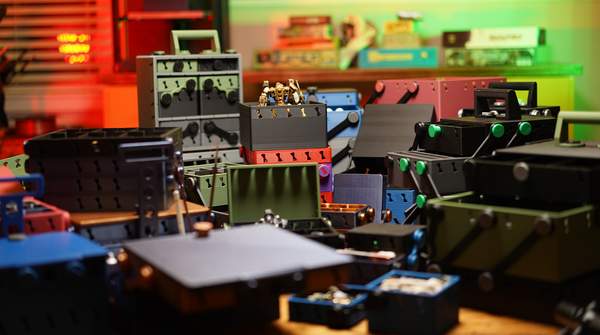
Modi Boxi puts more emphasis on customization. Its modular system lets users create different configurations from the available STL files rather than relying on one predetermined arrangement. The Core system includes small, medium, and large Boxi sizes, while the XL version provides a larger format for higher-capacity builds.
For gamers searching for 3D printable miniature storage, that flexibility is one of Modi Boxi's clearest differences from traditional cases.
Storage for Warhammer, D&D, and Other Tabletop Games
The type of games a storage system needs to support can also influence the decision.
Tabletop Tyrant is primarily relevant to gamers looking for dedicated physical miniature storage. That makes a ready-made case a practical option for players who want to keep their models together without designing or printing their own system.
Modi Boxi covers a wider range of tabletop storage needs. Its applications include Warhammer army storage, Dungeons & Dragons storage, board game storage, and trading card game storage. The system can therefore extend beyond miniature cases into a broader gaming organization setup.
For Warhammer players, the system includes modular storage designed around army organization, with adjustable tray depths and the Modi Bolt connection system. For tabletop RPG players, Modi Boxi can accommodate miniatures, dice, cards, tokens, and other campaign accessories.
That broader use makes it relevant for hobbyists looking for a storage solution for D&D, Warhammer, and tabletop games rather than a case for miniatures alone.
Expansion Makes a Difference as Collections Grow
One of the biggest differences between a traditional case and a modular 3D-printable system is what happens when the collection gets bigger.
With a ready-made case such as a Tabletop Tyrant product, the storage capacity is tied to the physical product you purchased. If your collection eventually exceeds that capacity, you may need another case or a different storage configuration.
Modi Boxi is designed around expansion. Users can print additional components as their storage needs change instead of having to replace the entire system. The Modi Boxi XL provides a larger format, while Pro Pack 1 and Pro Pack 2 add new storage functions and components.
Pro Pack 1 adds more than 150 STL files, including paint holders, drawers, card holders, DIY trays, support walls, and other components. Pro Pack 2 adds more than 650 STL files, including the Swivel System, Half Boxis, and half drawers for smaller printers.
For a growing collection, that means the storage system can evolve without requiring a completely new starting point.
3D Printing Is the Main Consideration With Modi Boxi
The biggest advantage of Modi Boxi is also the main requirement. You need access to an FDM 3D printer to turn the digital STL files into physical storage.
Modi Boxi Core works with FDM printers with a bed size of at least 180 x 180 mm, while a 250 x 250 mm bed is recommended. The files are designed to print without supports, and the finished components can be assembled without tools.
The process involves downloading the STL files, preparing them in a slicer, printing the pieces, and assembling the system. Modi Boxi also provides free counter test files, giving prospective users a way to test the printing concept before committing to a larger setup.
For someone without a 3D printer, a finished Tabletop Tyrant case may be the simpler route. For someone who already owns a printer, however, Modi Boxi turns that equipment into another way to create and expand tabletop storage.
Organization Beyond Miniatures
Miniature storage is only one part of a tabletop gaming setup. Many hobbyists also need somewhere to keep paints, cards, dice, tools, and other accessories.
This is where Modi Boxi can extend beyond the traditional miniature case. The Pro Pack 1 expansion specifically adds paint holders and drawers, along with card holders, trays, and other storage components.
That gives Modi Boxi a broader role as a 3D-printable storage solution for tabletop gamers. Instead of treating miniature storage, paint storage, and gaming accessories as separate systems, users can build them into a modular setup.
Tabletop Tyrant remains relevant for players who primarily want dedicated physical miniature storage. Modi Boxi has an advantage for hobbyists who want their storage to cover several parts of the gaming space.
Tabletop Tyrant vs. Modi Boxi for Different Hobbyists
Both approaches can work, but they suit different priorities.
Tabletop Tyrant may suit gamers who:
- Want a finished physical storage product
- Do not own or want to use a 3D printer
- Prefer to purchase storage rather than print and assemble it
- Need a straightforward solution for their existing miniature collection
Meanwhile, Modi Boxi may suit gamers who:
- Already own an FDM 3D printer
- Want customizable miniature storage
- Expect their collection to grow
- Want storage for miniatures, paints, cards, and other tabletop gear
- Prefer a modular system they can print and expand over time
A Flexible Option for Growing Tabletop Collections
For tabletop gamers comparing storage in 2026, the choice increasingly comes down to how much flexibility they want from their setup.
Tabletop Tyrant provides a conventional route to miniature storage. It can be appealing when the priority is purchasing a finished product and using it immediately. Modi Boxi takes more of a build-your-own approach, combining STL files, modular components, different Boxi sizes, and expansion packs into a system that can develop alongside a collection.
For gamers who already have an FDM printer, that distinction can make Modi Boxi particularly compelling. Its Core, XL, Pro Pack 1, and Pro Pack 2 options give users multiple ways to build storage for miniatures and broader tabletop equipment.
If you're looking for the best 3D-printable storage solution for your tabletop setup, Modi Boxi is worth exploring, particularly if customization and future expansion matter as much as the initial storage capacity. Explore Modi Boxi's collection and start building a tabletop storage setup around your collection.