The single design difference that separates modern wireless charging from its frustrating early years is magnetic alignment. The original Qi standard left coil positioning to the user, which meant misalignment, energy lost as heat, and inconsistent charging speeds. Apple's MagSafe solved that with a ring of magnets that snaps an iPhone into the correct position, and the Wireless Power Consortium's Qi2 standard, announced in 2023 and based on MagSafe, carries that same principle into a universal standard. Understanding that one mechanism is enough to evaluate nearly any wireless charger on the market.
The Basics of Wireless Charging: Inductive Power Transfer
Wireless charging in phones and earbuds works by inductive power transfer. A coil of wire in the charging pad carries an alternating current, which generates an oscillating magnetic field. That field induces a current in a matching coil inside the device, and the energy is converted back into electricity to charge the battery. No contacts touch; power crosses the gap entirely through the field.
The catch is that inductive transfer only works well when the two coils line up precisely. As ZAGG's comparison of the two systems puts it, Qi "uses inductive power transfer, which requires precise alignment to avoid inefficiency and slower charging." When a phone sits slightly off-center on a pad, the coupling between the coils weakens. Less of the transmitted energy reaches the device coil, and the remainder is dissipated as heat rather than stored charge.
This is why the classic Qi experience feels unreliable: charging works, but the speed varies with every placement, and the pad or phone can become noticeably warm. The same trade-off appears in Optimum's overview of wireless charging, which lists among the category's cons that it is "noticeably slower than wired" and "less efficient than wired; some energy is lost as heat." The physics of loose inductive coupling, not wireless charging itself, is the culprit.
MagSafe: Apple's Magnetic Solution for iPhones
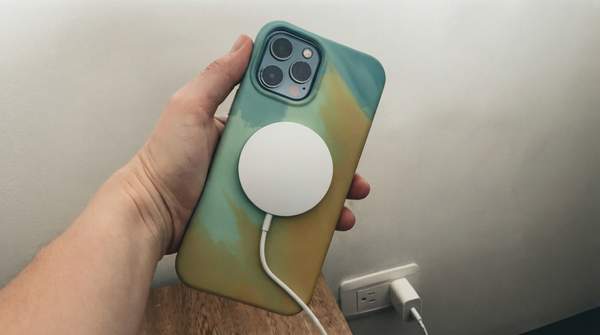
Apple introduced MagSafe with the iPhone 12 series in 2020, as Belkin's wireless charging guide recounts. MagSafe is a proprietary wireless charging system that magnetically attaches to the back of compatible iPhones. Inside the MagSafe Charger, a ring of rare-earth magnets surrounds a standard Qi wireless charging coil, so the magnets physically pull the phone into the exact position where the coils couple best.
The result is that alignment stops being the user's problem. The magnets snap the iPhone into the correct position every time, which removes the main source of energy loss in a Qi session. That guaranteed coupling is what enables the higher power figures: the first MagSafe Charger delivers up to 15 W to the iPhone 12, 12 Pro, and newer models, with the smaller iPhone 12 Mini and 13 Mini supporting 12 W. That is a meaningful jump over typical loose-pad Qi charging, though still short of wired speeds — The Wall Street Journal found the MagSafe Charger charged at half the speed of a 20 W wired charger.
The trade-off is compatibility. MagSafe's magnetic attachment only works with iPhone 12 and later models and MagSafe-compatible accessories, so the ecosystem is narrower than Qi's, and ZAGG notes the higher cost of MagSafe accessories as a further downside. The secure magnetic connection also enables an accessory ecosystem — wallets, stands mounts, and car mounts that hold the phone physically as well as charge it.
Wireless Charging Standards: A Comparative Overview
Isolating the alignment mechanism makes the three standards easy to compare. The table below traces how the move from user-placed coils to magnetically aligned coils changes speed, efficiency, and compatibility across the three standards.
| Standard | Alignment Mechanism | Maximum Charging Speed | Primary Compatibility | Governing Body / Developer |
|---|---|---|---|---|
| Original Qi | User placement on the pad; no alignment aid | Slower and inconsistent; speed varies with coil position | Broad compatibility across many devices and brands | Wireless charging standard governed through WPC certification |
| MagSafe | Ring of magnets ensures precise coil alignment; snaps into position | Up to 15 W for compatible iPhones (12 W for iPhone 12 Mini and 13 Mini) | iPhone 12 and newer; MagSafe-compatible accessories | Apple (proprietary) |
| Qi2 | Magnetic alignment based on MagSafe's design | Up to 15 W | Cross-brand universal standard for magnetically aligned devices | Wireless Power Consortium (announced 2023) |
The pattern in the table is the article's core finding: Qi2 takes MagSafe's central advantage — guaranteed magnetic alignment — and standardizes it across brands, rather than leaving it inside Apple's ecosystem. Belkin, a WPC member since 2015, describes Qi as the long-standing benchmark for compatibility and performance, and the Qi2 announcement as the point where magnetic alignment became a universal feature rather than a proprietary one.
Evaluating Wireless Chargers: What to Look For
With the alignment principle understood, evaluating a charger becomes straightforward. First, check which standard the device and charger share: an iPhone 12 or later gains the most from MagSafe or Qi2 accessories; a non-Apple phone benefits from Qi2's magnetic alignment where supported, and falls back to plain Qi otherwise. Second, treat the wattage figures as theoretical maximums defined by the standard — actual charging speed depends on the specific charger, the device, the power adapter used, and thermal conditions. The 15 W MagSafe figure, for instance, applies only to compatible iPhones, and even then a 20 W wired charger was measured charging twice as fast.
Third, weigh the trade-offs rather than assuming newer is universally better. Qi's weakness is inconsistent speed from misalignment; MagSafe's weaknesses are limited compatibility and higher accessory cost; Qi2 aims to combine magnetic alignment with cross-brand reach. A buyer who mostly tops off an iPhone during the day may find the secure snap-on connection and consistent speed worth the premium, while a household with mixed devices may still lean on broad Qi compatibility.
Two boundaries keep this analysis honest. It covers inductive charging in consumer electronics like phones and earbuds — not resonant charging or wireless power for larger applications such as electric vehicles. And it describes standards, not products: the figures here characterize what each standard permits, not a review of any particular charger.
Making Informed Choices for Your Wireless Charging Needs
When evaluating wireless charging products, prioritize chargers and devices that support magnetic alignment — MagSafe or Qi2 — for optimal speed, efficiency, and reliability. The reasoning is direct: misalignment is the main cause of energy lost as heat and inconsistent power delivery in loose-pad Qi charging, and magnetic rings remove that variable by fixing the coils in the optimal relative position.
The measurable indicator to watch for is consistent, fast charging without excessive heat, and a secure physical connection between the device and charger. If a charger holds the phone firmly in place, delivers its rated speed session after session, and stays cool under normal conditions, the alignment mechanism is doing its job; if speed varies with placement or the pad runs hot, it is not.