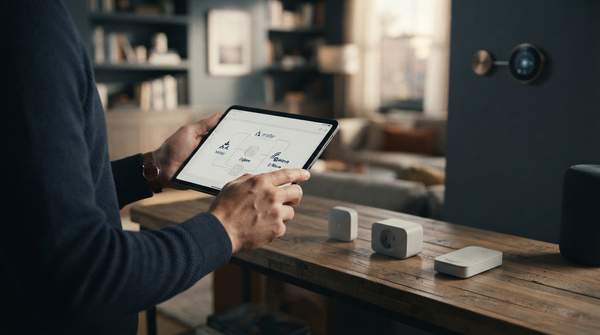
The single most important thing to understand before buying smart home devices is that Matter, Zigbee, and Z-Wave are not competing on the same level. Zigbee and Z-Wave are complete wireless communication protocols that move data between devices; Matter is an application standard that sits on top of other networks and defines how devices understand one another. That distinction drives every practical decision: if you want maximum brand flexibility and future-proofing, Matter is the priority; if you want a dense network of low-power sensors, Zigbee excels; if you need long-range, interference-resistant communication, Z-Wave's sub-GHz design is the strength to build on.
Understanding Smart Home Communication: Protocols vs. Application Layers
Smart home standards operate at different layers of the networking stack, and confusing them is the most common purchasing mistake. Zigbee and Z-Wave are full communication protocols: they define how a radio signal carries data from a sensor to a hub. Matter, by contrast, is an application layer protocol that runs on top of different physical layer protocols, including Thread, Wi-Fi, and Ethernet, as the electronics supplier DFRobot explains in its protocols overview. Its goal is a unified standard enabling interoperability among smart home devices from different brands.
A useful framing comes from ZDNET contributor Maria Diaz, who tested Thread, Zigbee, and Matter in her own home: where Thread and Zigbee govern how devices connect, "Matter is how your devices understand each other." Matter's goal is not to connect devices but to make them compatible, so many brands can work seamlessly together. Because Matter is a software layer that can be added over the air, manufacturers such as Apple, Amazon, Google, and Samsung were able to update existing devices to become Matter-compatible when the standard launched.
The practical consequence: Matter does not replace Zigbee or Z-Wave radios. It can work with existing Zigbee and Z-Wave devices through bridges, which means an established network is not obsolete when you adopt Matter. Silicon Labs, a chipmaker whose comparison of Matter and Z-Wave is written from the industry side, frames the key question for consumers as whether existing devices using other technologies can work with Matter devices — and the answer runs through bridging rather than replacement.
Zigbee: The Mesh Network for Low-Power Devices
Zigbee is a low-power wireless mesh networking protocol. In a mesh, devices relay messages for one another, so every mains-powered device strengthens the network rather than just consuming it. Zigbee operates on the 2.4 GHz frequency band, and sometimes 915 MHz, according to SafeWise reviewer Alina Bradford. The 2.4 GHz band is shared with Wi-Fi and even microwave ovens, so Zigbee networks can experience interference in Wi-Fi-dense homes.
That frequency choice is a deliberate trade-off. As Bradford notes, Zigbee is faster when using 2.4 GHz, but you sacrifice power consumption for speed, so battery-powered devices may need more frequent battery changes. Aqara's comparison table lists Zigbee's power draw at 40 mA against Z-Wave's 2.5 mA, with a transmission distance of about 100 meters for both.
Where Zigbee works best, according to Aeotec's range comparison, is in dense device networks — smart lighting and sensor farms — where mesh redundancy matters more than per-hop distance and where low device costs are a priority. Zigbee devices require a compatible hub or bridge to join a broader smart home system, and a Zigbee device cannot communicate directly with a Z-Wave device because the two use different radio frequencies.
Z-Wave: Long Range and Reliable Sub-GHz Communication
Z-Wave is also a low-power wireless mesh protocol, but it uses sub-GHz frequencies: 908 MHz in the US and 868 MHz in Europe, with SafeWise citing the specific US frequency of 908.42 MHz. Because these bands sit below the crowded 2.4 GHz range, Z-Wave experiences less Wi-Fi interference and achieves better wall penetration than Zigbee, according to the Gladys Assistant guide's author, Pierre-Gilles Leymarie.
The trade-off mirrors Zigbee's: Z-Wave is less than half as fast, as Bradford puts it, but battery life is longer. Z-Wave's defining feature is strict certification, which has earned it a reputation for reliable cross-brand behavior and a large installed base. Leymarie also notes its history: Z-Wave was proprietary for most of its life, only opening as a ratified standard around 2020, its devices tend to be pricier, and many manufacturers are now shifting new products to Matter and Thread.
For sizing, Aeotec describes Z-Wave Classic as the reliable workhorse for typical smart homes of up to roughly 232 devices, offering better wall penetration and guaranteed interoperability than Zigbee, while Z-Wave Long Range extends to large properties, outdoor devices, and multi-dwelling units that need long-distance direct communication with minimal repeater infrastructure. Like Zigbee, Z-Wave requires its own specific gateway or hub, though it has a large catalog of compatible devices that work together.
Matter: The Unifying Application Layer for Interoperability
Matter's defining goal is to eliminate the compatibility guessing game. A key aim, as Silicon Labs describes it, is the ability to add smart devices to a home without having to decipher which platform the product works with. Matter is IP-based, which makes it compatible with popular voice assistants and other IP-based devices, easing integration into existing ecosystems. On security, Silicon Labs credits Matter with end-to-end encryption, device certification, and cloud integration, while noting that Z-Wave also offers encryption and device authentication but no built-in cloud service.
Because Matter rides on underlying networks rather than defining its own radio, its characteristics vary with those networks. Aqara's comparison reflects this: Matter's power consumption "varies, depending on underlying protocols," and its roughly 100-meter transmission distance is a function of the transport in use. Matter is compatible with both Zigbee and Z-Wave devices through bridges, which is why it functions as an aggregation layer rather than a rip-and-replace migration.
Smart Home Standards: A Comparative Decision Framework
The table below contrasts the three standards across the dimensions that actually drive purchasing decisions, drawing the parallel comparison from the sources above. The key analytical point is that the rows are not symmetrical: Zigbee and Z-Wave are full-stack protocols with fixed radio characteristics, while Matter is an interoperability layer whose behavior depends on the network underneath it.
| Dimension | Zigbee | Z-Wave | Matter |
|---|---|---|---|
| Technology type | Low-power wireless mesh communication protocol | Low-power wireless mesh protocol on sub-GHz frequencies | Application-layer standard running over networks such as Thread, Wi-Fi, and Ethernet |
| Primary goal | Dense, low-cost device networks with mesh redundancy | Reliable, longer-range communication with strict certification | Universal cross-brand compatibility |
| Compatibility | Needs a Zigbee hub; not compatible with Z-Wave; works with Matter via bridges | Needs a Z-Wave hub; not compatible with Zigbee; works with Matter via bridges | Compatible with major voice assistants and IP-based devices; bridges to Zigbee and Z-Wave |
| Power consumption | Higher draw (40 mA per Aqara's table); faster at 2.4 GHz but more battery changes | Lower draw (2.5 mA per Aqara's table); longer battery life at slower speed | Varies with the underlying protocol |
| Frequency and range | 2.4 GHz (sometimes 915 MHz); ~100 m; can interfere with Wi-Fi | 908.42 MHz in the US, 868 MHz in Europe; ~100 m; better wall penetration, less Wi-Fi interference; Long Range variant for large properties | ~100 m via its transports; no radio of its own |
| Security | Encrypted mesh communication | Encryption and device authentication; no built-in cloud service | End-to-end encryption, device certification, and cloud integration |
Read against priorities, the framework yields a clear verdict. Choose Matter when maximizing device choice and multi-ecosystem support matters most, since it lets brands work together without platform checks. Choose Zigbee for dense, low-power sensor and lighting networks where device cost and mesh redundancy dominate. Choose Z-Wave when long-range, interference-resistant communication and certified cross-brand reliability are the priority — particularly in larger homes or for outdoor devices, where Z-Wave Long Range applies.
Making Your Smart Home Decision: Prioritizing Interoperability or Protocol Strengths
Decide whether to prioritize Matter's broad interoperability for future-proofing and multi-ecosystem support, or to build on the established strengths of Zigbee (dense, low-power networks) or Z-Wave (long-range, reliable communication) for specific device needs. The two paths are not mutually exclusive: because Matter bridges to both protocols, an existing Zigbee or Z-Wave installation can remain the radio backbone while Matter handles cross-brand compatibility on top.
The measurable indicator of a good decision is the compatibility of new smart home devices with your chosen primary standard — Matter, Zigbee, or Z-Wave — and the seamless integration of devices from different brands within your ecosystem. Before each purchase, check the device's stated standard and whether your hub bridges it; if new devices from different brands join and cooperate without platform workarounds, your chosen architecture is doing its job.
Sources
- Smart Home Protocols Explained: Wi-Fi vs Bluetooth vs Zigbee vs Z-Wave Vs Thread and Matter — Projects and Tutorials - DFRobot
- After testing Thread, Zigbee, and Matter, here's how I'm building my smart home differently - ZDNET
- Matter vs Z-Wave: What You Need to Know - Silicon Labs — SILABS
- What's the Difference between Zigbee and Z-Wave? — SafeWise
- Zigbee vs Z-Wave vs Matter: Which is Better for Your Smart Home? — Aqara LLC
- Zigbee vs. Z-Wave vs. Z-Wave LR: Range Compared - Aeotec
- Zigbee vs Z-Wave vs Matter vs Thread (2026 Guide) — Gladys Assistant