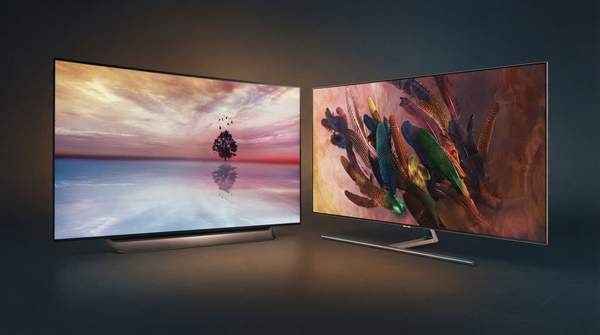
The fastest way to choose between OLED, QLED, and Mini-LED is to look at how each one makes light. OLED pixels emit their own light and switch off completely, which produces true blacks and exceptional contrast — the strongest fit for a dark home theater. QLED and Mini-LED sets are LCD panels lit from behind, which pushes their peak brightness higher and makes them the better fit for bright, sunlit rooms and HDR content. The trade-off is fundamental rather than incidental: a backlight, however refined, cannot match a pixel that produces zero light when switched off.
Understanding Display Technologies: OLED, QLED, and Mini-LED
Despite the similar-sounding names, these three labels describe two different families of television. OLED — organic light-emitting diode — is a self-emissive technology: each pixel generates its own illumination. QLED and Mini-LED, by contrast, are both variations of LCD, as Hisense's technology guide explains. An LCD television relies on a backlight shining through a stack of display materials to create an image, as Popular Science's Nicholas Ware describes it. QLED adds a quantum dot layer to that structure; Mini-LED upgrades the backlight itself. Understanding which side of that divide a TV falls on explains most of what you will actually see on screen.
OLED: Self-Emitting Pixels for Perfect Blacks
OLED panels do not require a backlight at all. Instead, each individual pixel generates its own light — and, crucially, can switch itself off completely. When a pixel is off, it produces zero light. That single design decision is what separates OLED from every backlit alternative: because there is no shared light source, there is no backlight bleed, and dark scenes render with true black levels and near-infinite contrast ratios. Hisense describes the difference in dark scenes — cinema, drama, night-time sport — as immediately visible.
The same structure gives OLED another advantage that is easy to overlook in a spec sheet. Because each pixel emits its own light directly, OLED delivers excellent off-axis viewing, with color and contrast remaining consistent even from wide angles. Samsung also credits OLED with accurate color reproduction, noting that advancements like OLED HDR deliver powerful brightness and deeper contrast enabled by every pixel. The counterweight is peak brightness: backlit technologies can simply push more light through the panel, which matters in a bright room.
QLED: Quantum Dots for Enhanced Brightness and Color
QLED stands for quantum light-emitting diode, but the name is slightly misleading — it is a type of LCD TV that uses a quantum dot filter, a layer of tiny semiconductor crystals positioned between the backlight and the LCD panel. Those dots are precisely engineered to emit specific wavelengths of light, producing a far wider and more accurate color range than the standard RGB filters found in older LED TVs. The result, according to Hisense, is a brighter, more vibrant and more consistent picture, even at lower brightness levels.
Because QLED builds on LED technology rather than replacing it, it can offer picture quality closer to more expensive alternatives at a more affordable price. Its practical strengths are concrete: high peak brightness that cuts through glare with ease in bright rooms, richer and wider color for HDR and 4K content, and high refresh rates with low input lag that keep up with gaming and sport. For everyday family viewing across a range of price points, Hisense rates it a strong all-round performer.
Mini-LED: Precision Backlighting for Superior Brightness and Contrast
Mini-LED keeps the LCD architecture but changes the scale of the backlight. Instead of a handful of larger LEDs behind the panel, the backlight is composed of thousands of tiny LEDs arranged in independently controlled local dimming zones. More zones mean finer control over which parts of the screen are bright and which are dark, which deepens blacks and lifts highlights simultaneously — the combination that HDR content rewards most.
How close does this get Mini-LED to OLED? Popular Science's assessment is measured: the deep blacks OLED promises are essentially available with Mini-LED, and some Mini-LED TVs offer up to 3,000 backlight zones — but you do not get the same pixel-level control over black levels. That difference is likely barely noticeable to the average consumer, in Ware's assessment. Mini-LED also scales to cost at a more expensive clip than QLED, functioning as the premium version of the same base technology. Hisense's verdict is that for premium HDR viewing and home cinema, Mini-LED — especially combined with a quantum dot layer — is the step up worth making.
OLED vs. QLED vs. Mini-LED: A Performance Comparison
The table below maps each technology's light-generation method to its resulting strengths, so the connection between design and on-screen performance is visible at a glance. Read down each column to see why OLED dominates contrast while the backlit technologies dominate brightness.
| Technology | How It Works (Light Source) | Best For (Use Case) | Contrast Performance | Brightness Performance |
|---|---|---|---|---|
| OLED | Each pixel is self-emissive and can switch off completely; no backlight required. | Cinematic viewing in dark rooms; also suitable for gaming and wide-angle seating. | True blacks with no backlight bleed and near-infinite contrast; immediately visible in dark scenes. | Very good, with accurate color and deep contrast, but generally below backlit alternatives in peak brightness. |
| QLED | LCD panel with a quantum dot filter between the LED backlight and the panel; dots emit specific wavelengths. | Bright rooms, vivid color, HDR and 4K content, gaming and sport, everyday family viewing. | Strong — improved over standard LED, but blacks are still lit by a shared backlight. | Excellent peak brightness that cuts through glare. |
| Mini-LED | LCD panel with a backlight of thousands of tiny LEDs in independently controlled local dimming zones. | Premium HDR viewing, home cinema, gaming, and large screen sizes across varied lighting. | Excellent — deeper blacks than standard QLED through precise zoned dimming, though not pixel-level like OLED. | Excellent — higher peak brightness than standard QLED, ideal for HDR highlights. |
The pattern the table reveals is consistent: the two backlit technologies trade pixel-level black control for raw light output, while OLED trades maximum brightness for perfect blacks. Everything else — color vibrancy, HDR punch, glare handling — follows from that starting point.
Comparative Performance: Contrast, Brightness, and Color Accuracy
On contrast, OLED wins on principle: a pixel that emits zero light cannot leak, so no backlit design can fully match it. Mini-LED closes the gap substantially through zoned dimming — enough that Popular Science calls the remaining difference barely noticeable for most viewers — while standard QLED sits behind Mini-LED in local dimming, black depth, and peak brightness, as Hisense's comparison notes, though it can offer better value at a lower price.
On brightness and color, the ranking inverts. QLED's quantum dots convert backlight output into a wider, more accurate color range, and Mini-LED adds higher peak brightness on top of strong color when combined with a quantum dot layer. Samsung frames the same split from its own product line: its Mini LED-based Neo QLEDs are known for brightness and HDR performance, making them ideal for HDR content, while OLED excels at deep blacks, vivid contrast, and a cinematic experience. Hisense's guide adds a further caveat worth weighing: OLED carries a higher burn-in risk than the backlit technologies, alongside its higher price.
Making Your Choice: The Right Display for Your Home
Choose OLED for unparalleled contrast and cinematic viewing in dark environments, or opt for Mini-LED/QLED for superior brightness, vibrant colors, and excellent performance in well-lit rooms and with HDR content. In practice, that decision reduces to two questions: how much light is in your room, and what do you watch most?
If your viewing happens in a dim or darkened space — movie nights, drama series, evening sport — OLED's pixel-level blacks deliver the most immediately visible benefit. If your TV lives in a sunlit living room, or HDR films and fast-moving sport and gaming dominate your habits, a QLED or Mini-LED set's higher peak brightness will matter more than perfect blacks, and Mini-LED's zoned dimming makes it the stronger pick for premium home cinema among backlit options. Budget is the final filter: Hisense's pricing ladder runs from standard LED through QLED and Mini-LED up to OLED, with Mini-LED scaling to cost at a more expensive clip than QLED.
The observable signal is the satisfaction with picture quality in the chosen viewing environment and with preferred content types — deep blacks in a dark room for movies, or bright, clear images in a sunlit room for sports. If you can, view the same dark scene and the same bright HDR scene on an OLED and a Mini-LED side by side in lighting that matches your own room: the contrast-versus-brightness trade-off described here is exactly what your eyes will confirm.
Sources
- UK
- QLED vs. OLED vs. Mini-LED: Understanding TV backlight tech — Popular Science
- Mini LED vs. OLED : What's the difference? — Samsung us