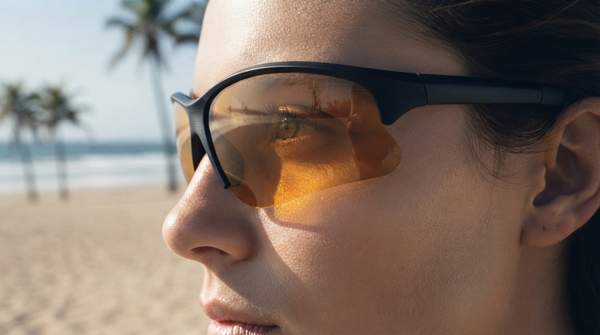
The single non-negotiable feature in any pair of sunglasses is a label reading "100% UV protection" or "UV400." Everything else — lens material, polarization, mirror coatings, tint darkness — is a matter of comfort, performance, or durability, not safety. The U.S. Food and Drug Administration and the American Academy of Ophthalmology both direct buyers to look for that full-protection label, which covers both UVA and UVB radiation. Once that box is checked, the real decision becomes choosing a lens material whose trade-offs match how you actually live: polycarbonate for impact-heavy sports, glass for maximum clarity in gentler everyday use.
Lens Material Showdown: Polycarbonate vs. Glass
Most nonprescription sunglass lenses are made from some type of plastic, and among plastics, polycarbonate is the standout for active use. The American Academy of Ophthalmology notes that polycarbonate sunglasses can withstand stronger impacts than regular plastic lenses, which is why the material is so often recommended for sports. Its toughness is quantifiable: according to DSRT Standard, a maker of ANSI-certified eyewear, polycarbonate carries a ballistic shatter resistance rating above 2.2mm — higher than nylon, standard plastic, or glass — and it is the material that allows a lens to meet ANSI Z87.1 impact standards while staying light enough for all-day wear.
Polycarbonate's weaknesses are the flip side of its strengths. Uncoated polycarbonate lenses tend to scratch easily, so the Academy of Ophthalmology advises buyers to make sure a scratch-resistant coating is included. On clarity, REI's expert buying guide rates polycarbonate as offering excellent impact resistance and "very good" optical clarity — good, but not the best available. In exchange, you get a lens that is affordable, lightweight, and low-bulk.
Glass occupies the opposite corner of the trade-off space. REI's guide describes glass as offering superior optical clarity and superior scratch resistance — the highest visual quality of the common materials, with no coating needed to keep it that way. But glass is heavier than other materials and more expensive, and it behaves differently under impact: rather than chipping or shattering like regular plastic, glass will "spider" — crack in a spreading web pattern — when struck. That makes it a poor match for fast-moving balls, trail debris, or any activity where a lens is likely to take a hit.
One caution applies to both materials, and to every other lens on the shelf: darkness is not protection. The Academy of Ophthalmology warns shoppers not to assume that the darker the lens, the more it will protect their eyes — only sunglasses with 100% UV protection provide the safety you need. A dark lens without UV filtering can be worse than no sunglasses at all, because it prompts your pupils to dilate behind inadequate filtering.
Lens Material Decision Guide
The table below compares the two most common lens materials across the dimensions that matter most when choosing between them. Use it to match the material to your primary activity: impact resistance and weight dominate for sports, while clarity and scratch resistance dominate for driving and everyday wear.
| Dimension | Polycarbonate | Glass |
|---|---|---|
| Optical clarity | Very good, though not the best available | Superior — the highest clarity of common materials |
| Impact resistance | Excellent; ballistic shatter resistance above 2.2mm; can meet ANSI Z87.1 standards | Will "spider" when impacted, though less likely to chip or shatter than regular plastic |
| Scratch resistance | Uncoated lenses scratch easily; requires a scratch-resistant coating | Naturally highly scratch-resistant |
| Weight | Lightweight and low-bulk | Heavier than other materials |
| Cost | Affordable | More expensive |
The comparison resolves cleanly by use case. For sports, racquet games, cycling, or any environment with flying debris, polycarbonate's impact advantage is decisive, and its scratch weakness can be solved with a coating. For low-impact everyday wear where visual quality is the priority — long drives, reading outdoors, extended wear — glass delivers the clearest view and shrugs off the abrasion of daily handling, at the cost of weight and price.
Choosing the Right Sunglasses for Your Lifestyle
Start every purchase with the label. Experts quoted by ABC7's health reporting are blunt about the hierarchy: "The biggest mistake people make is maybe not choosing a frame that's big enough to protect their eyes." Check the sticker or packaging for "100% UV protection" or "UV400" — the two labels mean protection against both UVA and UVB — and favor larger frames that shield more of the surrounding eye area.
Next, separate the essential from the optional. Polarization, mirror coatings, and lens tint are performance features, not safety features. A mirrored or flash coating is a reflective film applied to the lens surface that reduces glare by reflecting much of the light hitting it; because it makes objects appear darker than they are, lighter tints are often paired with it to compensate, as REI's guide explains. Polarization similarly cuts glare but does not add UV protection on its own. Tint darkness affects comfort and contrast, not filtering — a lightly tinted lens with full UV certification protects you more than a very dark lens without it.
Then match the material to the activity. For sports and high-energy outdoor use, choose polycarbonate with a scratch-resistant coating, and if the activity involves genuine impact hazards — outdoor work, shooting sports, fast projectiles — look for ANSI Z87.1 certification, which is stamped on compliant frames and lenses. For everyday wear where durability means scratch resistance rather than impact survival, glass offers the clearest, most abrasion-proof option if weight and cost are acceptable.
Finally, consider the practical coatings that extend usability rather than safety: REI's guide lists hydrophobic coatings to repel water, anti-scratch coatings to improve durability, and anti-fog coatings for humid conditions or high-energy activities. These are worthwhile conveniences, but they should never substitute for the UV label — and they cannot compensate for a lens material mismatched to your sport.
Make an Informed Choice for Eye Protection
Choose sunglasses with "100% UV protection" or "UV400" labels as the absolute minimum, then select lens material and optional features based on activity-specific needs. The reader confidently identifies and purchases sunglasses with appropriate UV labels and lens materials for their intended use. In practice, that means verifying the UV400 or 100% UV label on the sticker or packaging before comparing anything else, picking polycarbonate with a scratch-resistant coating — and ANSI Z87.1 certification where impacts are likely — for sports, and reserving glass for everyday clarity-critical wear where its weight and fragility under impact are acceptable trade-offs.
Sources
- How to Choose the Best Sunglasses to Avoid Sun Damage — American Academy of Ophthalmology
- ANSI Z87.1 Sunglasses for Outdoor Work: The One Pair You'd Actually We — DSRT Standard
- How to Choose Sunglasses — REI
- Picking the perfect pair: Tips for choosing sunglasses that actually protect your eyes — ABC7 Los Angeles