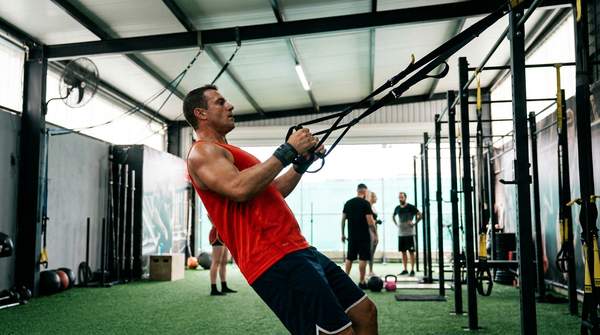
Hanging gymnastic rings have a habit of moving when you would prefer them to stay still. That instability can turn a familiar bodyweight exercise into a demanding test of strength and control, with the position of your hands and body influencing how challenging the movement feels.
Rings are among the training features visible at Iron Fitness in Limassol, where calisthenics is included in the gym’s bodyweight-training offering. For people who enjoy learning physical skills, the discipline presents an absorbing idea: changing how you move your body can create new challenges without requiring a heavier dumbbell.
Your Body Provides the Resistance
Calisthenics uses bodyweight as the main source of resistance. Exercises such as push-ups, squats, hanging movements, and other strength-based actions involve working against the weight of your own body.
The equipment requirements can be simple, yet the movements may be physically demanding. Supporting your body in a particular position requires muscular effort, while moving through that position introduces another challenge.
A push-up provides a familiar example. Your arms and upper body work against resistance while the muscles around your trunk help maintain your position.
The movement becomes more demanding or manageable depending on how it is performed. The relationship between your body, the supporting surface, and the direction of movement affects the effort involved.
Iron Fitness includes bodyweight exercises and calisthenics among its established programs. That makes the discipline a defined part of the gym’s training offer rather than simply one type of exercise that can be performed within the facility.
A Small Change in Position Can Change the Exercise
One of the distinctive features of calisthenics is how exercise difficulty can change through leverage and body position. The resistance is still your bodyweight, but the way that weight is supported and moved can alter the physical challenge.
Consider a push-up performed with the hands elevated on a stable surface. Compared with a conventional floor push-up, that position generally reduces the proportion of bodyweight supported by the upper body.
Moving the hands to the floor changes the demands. The exercise becomes more challenging for many people, even though no conventional weight has been added.
Assistance, leverage, and range of motion provide other ways to adjust bodyweight exercises. They create opportunities to approach a movement at different levels of difficulty.
This is part of what makes calisthenics interesting to practice. Someone can spend time developing a familiar exercise before attempting a variation that places greater demands on strength or control.
The progression has a physical logic. A movement that initially requires considerable concentration may become more manageable, allowing the person to attempt a new challenge.
Strength and Control Develop Together
Completing a bodyweight movement requires muscular effort, but strength alone does not determine how the exercise looks or feels. Position, coordination, and movement control also influence the experience.
Someone may be able to complete a push-up while finding it difficult to maintain a consistent body position throughout the movement. Another person may perform fewer repetitions but concentrate on moving through a controlled range.
These differences make technique an interesting part of calisthenics. Practice involves becoming familiar with how the body should move and recognizing what makes a particular exercise demanding.
There is satisfaction in noticing improvements that are not immediately visible through a repetition count. A position that once felt unstable may become steadier, or a movement that required considerable concentration may begin to feel more familiar.
The progression resembles learning a physical skill. The exercise itself becomes something to understand, refine, and eventually perform with greater confidence.
For people who enjoy that process, calisthenics provides an additional reason to return to training. There is always another aspect of movement to practice.
Rings Introduce a Different Challenge
Gymnastic rings add another dimension because the supporting equipment is suspended rather than fixed. Their position can change as someone uses them, introducing demands that differ from performing an exercise against a stable surface.
During an appropriate ring-based movement, the participant may need to control the equipment while also maintaining their own body position. That combination can require considerable concentration.
A familiar type of exercise may feel different when the supporting surface can move. The resistance still comes largely from bodyweight, but the demands on stability and control change.
Ring training is frequently associated with advanced gymnastic skills. However, suspended equipment can be used for different exercise variations, and the challenge depends on the movement, body position, and available assistance.
Iron Fitness has hanging rings and other suspension equipment within its training environment. These provide recognizable equipment for people interested in developing bodyweight strength and control.
Their presence is particularly attractive when calisthenics is already an area of interest. Someone familiar with the discipline can recognize the equipment and imagine the kinds of movement challenges associated with it.
Progress Can Be a New Movement, Not a New Weight
Resistance training often uses heavier equipment as a visible marker of increasing difficulty. Calisthenics offers other ways to recognize development.
Someone might initially perform a movement using assistance, then gradually work toward a version that requires more bodyweight support. Another person may concentrate on maintaining a position longer or completing a more controlled range of motion.
A further progression may involve a different variation of an exercise. The movement changes, and the person performing it faces a new demand on strength or coordination.
That creates a distinctive sense of achievement. The reward is often being able to perform a physical action that previously felt out of reach.
It also encourages attention to the movement itself. Progress is experienced through what the body can do, how it responds to a challenge, and how control develops through practice.
Advanced skills are not required for this process to be enjoyable. Becoming more comfortable with a basic exercise can be satisfying long before someone develops an interest in complicated gymnastic movements.
Coaching Can Help Connect the Stages
Bodyweight exercises may appear straightforward because they do not always require elaborate equipment. Yet selecting an appropriate variation and understanding how to progress it can involve several decisions.
A trainer can provide guidance on the movement being practiced, explain an exercise variation, and offer feedback on technique. Those interactions can be especially appealing when someone wants to develop a specific physical skill.
Iron Fitness includes calisthenics in its advertised programs. Valentino Godeanu, who leads the gym, is also recommended specifically as a calisthenics coach in a testimonial published by the business.
The testimonial comes from Marina, who mentions calisthenics and bodybuilding among the interests for which she recommends him. Her feedback establishes a direct connection between the named trainer and the discipline.
That association goes beyond equipment availability. Iron Fitness presents calisthenics as a training interest, and a member has described Valentino within that particular coaching context.
The gym offers private personal sessions upon request, alongside semi-personal training. Those services provide ways to discuss bodyweight-focused coaching with the business.
The Appeal of a Skill You Can Keep Developing
Some people are drawn to training because they enjoy lifting heavier weights. Others particularly enjoy the physical challenge of learning how to support, balance, and move their own body.
Calisthenics speaks to the second interest. Its progressions invite people to become familiar with a movement, develop their ability, and attempt a more demanding variation when appropriate.
A controlled push-up, a stronger hanging movement, or a more stable position on suspended equipment can offer a recognizable goal. Each involves something the person can practice and experience directly.
This creates a different relationship with exercise from simply completing a prescribed number of repetitions. The movement becomes a skill worth developing, with its own challenges and satisfying moments of progress.
That attraction can remain meaningful at different levels of experience. A beginner may be interested in basic bodyweight exercises, while someone more experienced may enjoy exploring difficult variations.
Iron Fitness gives this interest a place within its broader fitness offering. Its combination of calisthenics, suspension equipment, and coached training provides a setting for people who find physical skill development engaging.
Calisthenics Gives Training Another Dimension
Calisthenics turns strength into something you can experience through increasingly controlled and demanding movements. Changes in position, leverage, and technique create new challenges while keeping the body itself at the center of the exercise. With calisthenics included in its programs and equipment suited to bodyweight training, Iron Fitness offers a recognizable destination for this discipline in Limassol. Contact the gym to enquire about calisthenics-focused coaching and the movements you would like to develop.