Barese is a word you might overlook while ordering bread. It points to Bari, the port city in southern Italy whose focaccia has its own traditions. Genovese, attached to a Pinsa elsewhere on Pala Bakery’s menu, points hundreds of miles north toward the basil and pesto of Genoa.
Pala is a Roman-inspired panificio in West Buckhead, Atlanta, but the names in its food selection reach across Italy. Florence appears in a salami panini, Calabria in a chile-topped Pinsa, and Naples in the pastry counter. The places are not a decorative theme: each has a recognizable culinary connection to a food the bakery actually lists.
Bari Gives Focaccia a Southern Italian Accent
Bari sits on the Adriatic coast of Puglia, a region with an especially rich bread tradition. Focaccia barese is one of the city’s characteristic everyday foods. In a familiar regional preparation, tomatoes and olives sit on a round bread whose dough may include semolina and boiled potatoes.
That combination comes from a food culture where baked goods can be a meal or a snack in their own right. The city is also associated with orecchiette pasta, panzerotti, and the rice, potato, and mussel dish known as tiella barese. Focaccia has a place among these recognizable local foods rather than serving as a generic substitute for pizza.
Pala Bakery lists Focaccia Barese in its bread section. The name identifies the regional reference; the listing does not detail the dough or toppings of Pala’s version, so the traditional tomatoes, olives, and potatoes should not be mistaken for its confirmed recipe.
Genoa Has Two Connections to the Bakery Counter
Genoa is a port city in Liguria, a northern coastal region with its own notable focaccia. Classic focaccia Genovese is associated with olive oil and dimples in the dough, while nearby Recco is known for a thin cheese-filled focaccia. These belong to a different set of regional bread traditions from Bari’s tomato-and-olive-topped version.
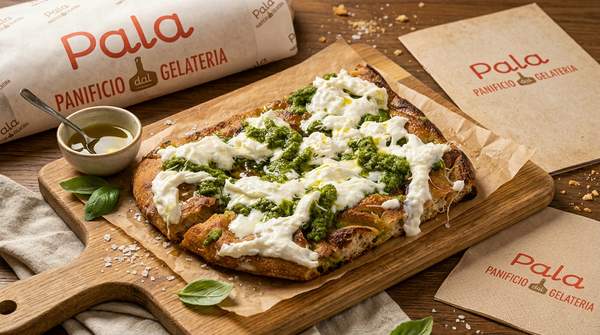
But it is pesto, rather than Ligurian focaccia, that brings Genoa most visibly into Pala’s menu. The bakery’s White & pesto Genovese Pinsa is listed with mozzarella, pesto containing pine nuts and Parmesan, and basil. The name sends the curious diner toward the city whose cuisine made the condiment famous.
Traditional pesto Genovese is associated with basil, garlic, pine nuts, hard cheese, olive oil, and salt, often worked together with a mortar and pestle. Liguria’s terrain and coastal climate form part of the background to its herb-centered cooking, but that culinary tradition should not be confused with a guarantee that Pala follows every traditional preparation rule.
Pesto also appears on Pala’s Pugliese w Mortadella panini, where it joins ricotta and mortadella on toasted Pane Romano. It moves from Pinsa to sandwich without losing its recognizable identity, connecting two kinds of bakery food through one ingredient.
Bari and Genoa demonstrate why Italian focaccia and flatbread are difficult to describe as a single national dish. Regional baking traditions differ, and the names on Pala’s menu make at least two of those places visible in Atlanta.
Florence Appears Inside a Panini
In another section of the Pala menu, Firenze is the Italian name for Florence. The Firenze salami/Golfetta panini is made with salami identified as coming from Florence, together with senape mustard, tomato, and mozzarella on toasted Pane Romano.
Italy’s cured-meat traditions vary significantly by region. Tuscan salami has its own history, just as other parts of the country are associated with mortadella, prosciutto, or soppressata. The Pala listing’s specific reference to Florence makes the origin of its salami part of the sandwich rather than merely an Italian-sounding label.
The rest of the combination is straightforward and inviting: cured meat, mustard, tomato, and mozzarella between toasted bread. It puts an ingredient associated with a Tuscan city into the Roman-inspired panini style that belongs to Pala’s bakery identity.
Calabria’s Chile Pepper Travels Beyond Calabria
Move south again and the menu gets hotter. Calabria, the region forming the toe of Italy’s boot, is strongly identified with peperoncino, the chile pepper used in sauces, cured meats, and other savory dishes. The association is strong enough that Diamante hosts a festival dedicated to the ingredient, with food and cultural events celebrating its place in local life.
One of Calabria’s other famous foods is ’nduja, a soft, chile-seasoned sausage. Regional kitchens use peperoncino in different forms, so its presence can be recognized across dishes that otherwise have little in common.
On Pala’s Calabrese Singolare, Calabrian chiles accompany soppressata, tomato sauce, mozzarella, and honey. The Sopressata & Fior di latte panini uses homemade robiola Calabrian chili cream with cured meat and mozzarella on toasted Pane Romano.
Naples Leaves Its Mark on the Sweet Counter
The regional story has a natural dessert ending. Sfogliatelle are closely associated with Naples and the surrounding Campania region, whose pastry shops are known for an extensive repertoire of sweets. The sfogliatella riccia is famous for its fine layered, shell-like pastry, while the frolla variation uses a smoother pastry casing.
Traditional fillings often bring together ricotta, semolina, and candied citrus. These are details of the Neapolitan pastry tradition, not a specification of the sfogliatelle Pala sells. The bakery’s menu confirms the item’s presence without naming its filling or exact style.
A pastry with such a recognizable regional history carries more than a name. The layered shape of riccia, the alternate frolla casing, and the rich pastry culture of Naples all help explain why sfogliatelle have endured as an Italian bakery favorite.
Pala also lists cannoli and cornetto, although their different backgrounds belong to other Italian food traditions. The sweet counter extends the geographical story beyond bread and savory fillings into the desserts that people associate with an Italian bakery.
Several Regions, One West Buckhead Bakery
Pala Bakery’s central inspiration may be Rome, yet the menu makes room for Bari’s focaccia, Genoa’s pesto, salami identified with Florence, Calabria’s chiles, and Naples’ sfogliatelle. At 1264 West Paces Ferry Road NW, those names lead to specific breads, Pinsa, panini, and pastries. Follow whichever one catches your attention; there is plenty of Italian geography to enjoy without leaving the bakery.