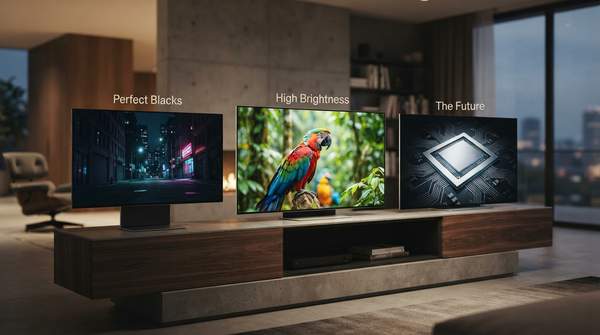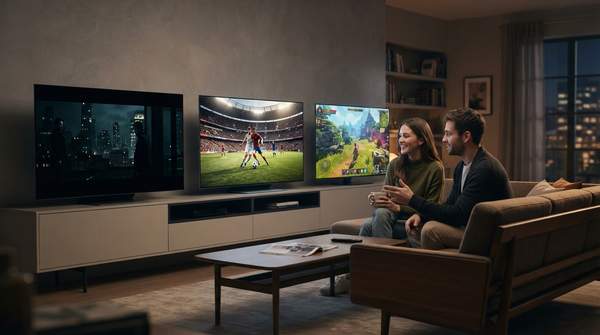
The short answer: OLED delivers the deepest blacks and the best dark-room picture, Mini-LED delivers the highest brightness for well-lit rooms, and QLED is a color-enhancement layer on LCD panels rather than a rival panel type. The right choice depends less on which technology is "best" and more on where you watch and what you watch. This guide explains how each technology works, compares their trade-offs, and maps them to the three most common scenarios: dark-room movies, bright-room sports, and gaming.
Understanding Display Technologies: OLED, Mini-LED, and QLED
The three names describe fundamentally different things. OLED is a self-emissive panel technology: each pixel produces its own light. Mini-LED is a backlighting method for LCD panels, using thousands of tiny LEDs arranged in individually controlled dimming zones. QLED, according to Hisense's technology explainer, is "a type of LCD TV that uses a quantum dot filter — a layer of tiny semiconductor crystals — positioned between the backlight and the LCD panel." That means QLED and Mini-LED are not competing categories: a single TV can use a Mini-LED backlight and a quantum-dot layer at once, as Samsung's Neo QLED line does.
This distinction matters for buyers. Choosing "QLED" does not mean choosing against OLED; it means choosing an LCD-based TV with enhanced color. The real performance divide is between self-emissive OLED panels and backlit LCD panels, with Mini-LED determining how well an LCD performs.
OLED: Perfect Blacks and Pixel-Level Control
OLED (Organic Light Emitting Diode) is a display technology where each pixel is individually lit, which Samsung's buying guide credits with "deep black levels and well-balanced contrast." Because a pixel can switch off entirely, dark scenes render with true black rather than the gray glow of a backlit panel. Samsung describes OLED as a premium technology "due to its ability to produce dark blacks and high contrast ratios," and notes it "excels at providing vibrant colors and rich blacks."
The trade-offs are real, though. A 2026 technical comparison by Marcus Bell at Shattered notes that OLED has "lower sustained full-screen brightness than backlit LCDs" and that "static-content wear remains a risk without careful habits" — the phenomenon known as burn-in. A KTC long-term testing update frames the longevity question around usage habits: dark-mode users can comfortably choose recent OLED panels, while "light-mode power users should lean toward Mini-LED for consistent performance over years of 12-hour sessions."
Mini-LED: Brightness and Precision Backlighting
Mini-LED improves LCD by shrinking the backlight into thousands of tiny LEDs, enabling precise local dimming zones behind the LCD panel. This precise control allows for enhanced brightness and contrast compared to traditional LED-backlit LCDs. Hisense's comparison table rates Mini-LED brightness as "Excellent" and contrast as "Excellent," positioning it for "Premium HDR viewing."
The weakness is structural: dimming happens by zone, not by pixel. Bright objects on dark backgrounds can exhibit "blooming" or "haloing" because local dimming is not as granular as OLED's pixel-level control. In practice, this means Mini-LED cannot fully match OLED's black levels, but it can far exceed OLED's brightness — the characteristic that matters most in a sunlit living room.
QLED: Vibrant Colors with Quantum Dots
QLED stands for Quantum Light-Emitting Diode, but despite the name it is an LCD technology. The quantum dot layer sits between the backlight and the LCD panel, filtering and refining the backlight's light to produce more saturated, accurate colors. Samsung says its quantum-dot-equipped Neo QLEDs deliver "a richer range of color across all brightness levels for bright, realistic hues."
Hisense's comparison rates QLED brightness and color as "Excellent" with "Very Low" burn-in risk, at a mid-tier price. The key point for buyers: QLED describes the color layer, not the backlight. A QLED TV with a standard LED backlight will behave like a conventional LCD; a QLED TV with a Mini-LED backlight combines strong brightness with enhanced color.
Display Technology Decision Framework
The table below maps each technology's mechanism to its resulting performance profile, synthesizing manufacturer explanations and independent reporting. Use it to match a technology to your dominant viewing habit.
| Technology | How It Works | Key Strength | Potential Weakness | Ideal Use Case |
|---|---|---|---|---|
| OLED | Each pixel emits its own light; pixels switch off individually | Perfect blacks and exceptional contrast | Lower sustained full-screen brightness; static-content wear risk | Cinematic viewing in dark rooms |
| Mini-LED | Thousands of tiny LEDs backlight an LCD panel through local dimming zones | Excellent peak brightness, contrast, and vibrant colors | Blooming/haloing around bright objects on dark backgrounds | Bright rooms, HDR content, general viewing |
| QLED | Quantum dot layer between backlight and LCD panel enhances color | Excellent, vibrant color reproduction with very low burn-in risk | Performance depends on the underlying backlight (standard LED vs. Mini-LED) | Bright rooms and color-critical viewing |
Read the table as a decision tool: identify your dominant environment first (bright or dark room), then your content type, then your budget. Hisense's pricing tiers place OLED highest, Mini-LED and QLED in the middle tier, and standard LED lowest.
Choosing Your Display: Scenarios and Recommendations
Movies in a dark room: OLED is the clear pick. Its pixel-level light control produces the deep blacks that make dark-scene detail visible, and Bell's October 2026 verdict is that "OLED wins on black level, viewing angle and dark-room picture quality."
Sports and daytime TV in a bright room: Mini-LED wins. Its high peak brightness keeps the picture legible against ambient light, and its local dimming maintains contrast. Bell's assessment is that "Mini LED sets suit bright rooms."
Gaming: OLED's per-pixel response suits fast, contrast-heavy content, and dark-mode users can choose recent OLED panels confidently per KTC's long-term testing. However, gamers who leave static HUD elements on screen for long sessions should weigh the static-content wear risk; heavy, sustained use with bright static interfaces favors Mini-LED for longevity.
Making Your Choice: Aligning Technology with Your Lifestyle
Choose a display technology based on your primary viewing environment (bright vs. dark room), content preferences (movies, sports, gaming), and budget, prioritizing either perfect contrast, peak brightness, or vibrant color reproduction. If your room is dark and you watch movies, OLED's perfect blacks are unmatched; if your room is bright and you watch sports, Mini-LED's brightness wins; if color vibrancy at a mid-tier price matters most, QLED delivers. The measurable indicator of a good decision is satisfaction with picture quality and performance in your most common viewing scenario after purchase — if the TV looks washed out in your living room or blacks look gray in your theater room, the technology-environment match was wrong.