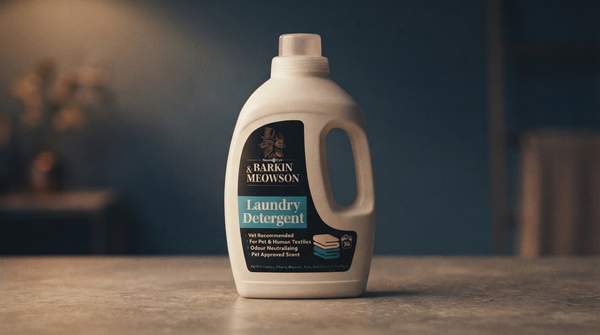
For most pets, a detergent marketed specifically for animals is more marketing than necessity — what actually matters is what's in the bottle. Veterinarian Dr. Liza Cahn, quoted by NBC Selected, puts it plainly: "Pet laundry detergent is more of a marketing term than a necessity, and most pets do not need a detergent specifically formulated for them." The real decision comes down to two questions: how sensitive is your pet's skin, and what is your primary laundry challenge — odors, stains, or hair? Answer those, and the right detergent type follows.
Understanding Your Pet's Laundry Needs
Pet fabrics accumulate a distinctive mix of soils. Tide's guidance on washing pet bedding, toys, and blankets notes that these items pick up dander, body oils, and protein-based messes — a combination that differs from typical human laundry. That difference is the entire basis of the "pet detergent" category, and it explains why the question is worth asking even if the answer is often "no."
Before choosing anything, it helps to separate the problems you're actually trying to solve. A dog bed that smells faintly of kennel presents a different challenge than a blanket covered in muddy paw prints, and both differ from a load where the real frustration is hair clinging to every fiber. Each of these maps to a different ingredient category, and none of them requires a "pet" label to address.
It's also worth noting the baseline: the CDC's guidance on cleaning and disinfecting pet supplies, as relayed by NBC Selected, recommends ordinary laundry detergent for machine-washing soft pet items and says it's fine to wash pet items with your own clothes. Specialization is an option, not a starting requirement.
Key Detergent Ingredients and Their Role
Four ingredient categories do nearly all the work relevant to pet owners. Surfactants are the primary cleaning agents in any detergent; enzyme-free products, as sofdog.com explains, clean effectively through plant-based surfactants, trading some stain power for gentleness.
Enzymes are biological catalysts that break proteins, fats, and starches into smaller pieces the wash can rinse away, according to Twin Cities Rescues — which also observes that most "pet" detergents are ordinary enzyme detergents with pet branding. Blueland adds a practical note: enzymes are engineered to work in cooler, less alkaline conditions, so enzyme-based detergents don't need hot water to be effective.
Fragrances and dyes do nothing for cleaning and carry irritation risk, which is why Tide recommends fragrance-free, dye-free detergents for pet items. Anti-static agents address a problem unique to pet households: the detergent manufacturer IKEDA explains that static electricity makes loose pet hair cling to fabrics, so anti-static performance is a formulation consideration, particularly for synthetic fabrics.
Pet Skin Sensitivity: What to Avoid
For a pet with easily irritated skin, the ingredient list matters far more than the label. The CDC, per NBC Selected, says detergent without dyes or fragrance may be a good choice for pets described as having sensitive skin — meaning a free-and-clear formula, pet-branded or not, is often the better pick.
Fragrance deserves particular caution. PawLab's Tyron Tromp points out that dogs have up to 300 million olfactory receptors and that cats are highly sensitive to perfumes — so much so that scents in laundry products can cause allergic bronchitis. Bedding that smells like exotic flowers is, in this framing, a solution nobody asked for.
Enzymes occupy a gray zone. Sofdog.com advises choosing enzyme-free if your dog has a history of skin reactions, and suggests a sequencing strategy: start with enzyme-free, and only add enzymes later if you need more stain power — because starting with enzymes and having a reaction means rewashing everything. Thorough rinsing also matters, since excess detergent residue can affect how fabrics feel and linger against skin.
Tackling Specific Laundry Challenges
Odors and stains. Pet odors and many pet stains are protein-based organic matter, which is exactly what enzymes target. Dr. Cahn notes that pet-specific products may contain enzymes or other ingredients designed to break down pet-related stains and odors, useful for bedding, towels, and toys — but a good enzyme detergent you already own may do the same job, as Twin Cities Rescues observes. Check the ingredient list for enzymes rather than the front label for a dog photo.
Pet hair. Hair is not a stain; it's a physics problem. IKEDA frames the goal not as a "pet hair dissolving detergent" but as a laundry system that cleans, loosens, rinses, and reduces reattachment — with anti-static performance as the key formulation lever, especially on synthetic fabrics. No enzyme will help here.
General washing. For routine cleaning of lightly soiled items, ordinary detergent does the job, per the CDC guidance. Reserve enzymatic firepower for loads that genuinely need it.
Decision Framework: Choosing the Right Detergent
Use two inputs — your pet's skin sensitivity and your primary laundry challenge — to arrive at one of three strategies. The matrix below classifies the combinations and shows the reasoning behind each recommendation.
| Pet Sensitivity | Primary Challenge | Recommended Strategy | Why |
|---|---|---|---|
| Low (no history of reactions) | Heavy odors or protein stains | Enzyme-based detergent, fragrance- and dye-free | Enzymes break down protein-based stains and odors; skipping fragrance and dye removes the most common irritants as a precaution. |
| Low | Pet hair on fabrics | Any free-and-clear detergent; prioritize anti-static performance | Hair clings because of static, not soil — anti-static agents, not enzymes, address it. |
| Low | General cleaning | Ordinary detergent | CDC guidance says ordinary detergent suffices for machine-washing soft pet items. |
| High (history of skin reactions) | Any, including odors and stains | Standard free-and-clear detergent, enzyme-free | Enzyme-free formulas clean via plant-based surfactants and are gentler; add enzymes later only if needed and tolerated. |
| High | Heavy soil persists on enzyme-free | Standard free-and-clear with enzymes, thoroughly rinsed | Enzymes handle heavy organic soil; complete rinsing minimizes residue that could irritate sensitive skin. |
The framework's logic: sensitivity sets the ceiling on what ingredients you can use, and the soil type sets the floor on what you need. A sensitive pet with heavy odors sits in the tension between those constraints — hence the staged approach of starting enzyme-free and escalating only if the cleaning result falls short.
Making the Best Choice for Your Pet's Comfort and Cleanliness
Pet owners should select a laundry detergent by first assessing their pet's skin sensitivity and then identifying their primary laundry challenge — odors, stains, or hair — to choose between enzyme-based, enzyme-free, or standard free-and-clear formulas. The pet-specific label is optional; the ingredient list is not.
How you'll know the choice worked: reduced pet skin irritation, effective removal of pet odors and stains from laundry, and less pet hair clinging to fabrics after washing. If irritation persists despite a fragrance-free, dye-free, well-rinsed formula, that's a matter for your veterinarian, not the detergent aisle. And if you simply want to evaluate a product yourself, the checklist is short: enzymes for organic odors and stains, anti-static agents for hair, and nothing fragranced or dyed for a sensitive pet.
Sources
- Pet laundry detergent is having a moment — should you be using it for your dog’s stuff? — NBC News
- Fragrance-Free Laundry Detergent for Pet Bedding — TIDE
- 7 Best hypoallergenic laundry detergents for dogs 2026 - sofdog.com
- Best laundry detergent for pet odors and dog smell — Twin Cities Rescues
- Best Laundry Detergent for Pet Odors: What to Look For — Blueland
- Best Laundry Detergent for Pet Hair: How to Remove Pet Hair from Clothes — IKEDA | Laundry Detergent Manufacturer & OEM Supplier
- Pet-safe laundry detergent: A laundry list of chemicals to avoid — PawLab