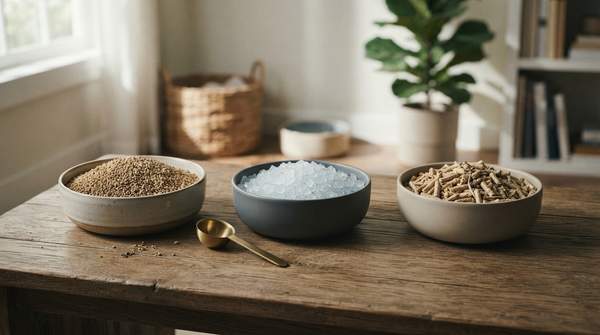
Choosing cat litter feels trivial until your cat stops using the box, your lungs itch from dust, or you learn the clay in that bag came from a strip mine. The five major litter families—bentonite clay, silica crystals, plant-based litters such as tofu or corn, wood pellets, and paper pellets—each trade off convenience, health, cost, and environmental footprint differently. Here we compare all five across six practical criteria and match them to common household situations, from asthmatic cats to multi-cat homes.
Why Litter Choice Is More Than a Preference Question
The Animal Welfare Association's guide frames litter selection as a health and behavior issue, not merely a housekeeping one: the right texture, scent, and dust level help prevent litter box avoidance, and a cat that refuses a new litter may be reacting to its feel or smell. Dust is the recurring health concern—some clay-based litters produce fine particles that, as OKC Vet Campus's veterinary article puts it, "can irritate the lungs of both cats and owners." The same article flags a second, quieter risk: cats track particles out of the box and ingest them while grooming, and ingested clumping litter can cause digestive blockages, especially in kittens.
The other axes of the decision are practicality and conscience. Clumping litter simplifies waste removal, while non-clumping and pellet-based litters often need full, more frequent replacements. And if sustainability matters to you, the Animal Welfare Association notes that clay production requires strip mining, whereas biodegradable options like corn, wheat, wood, and paper reduce landfill waste.
Bentonite Clay: The Default, With Real Costs
Bentonite is the classic clumping litter: a natural clay that absorbs moisture and binds into firm clumps you can scoop away, leaving the rest of the box clean. That scooping convenience is exactly why it also delivers strong odor control—trapped urine stops smelling on contact. Fidello's comparison guide rates it the cheapest option per liter and confirms its strong clumping, but lists its dust as medium to high and its environmental profile bluntly: a mined mineral that is not biodegradable.
So the trade-off is stark: the most affordable, easiest-to-clean litter is also among the dustiest and least sustainable. Dust can aggravate respiratory issues in sensitive cats and humans alike, and fine granules track readily out of the box on paws. Larger-grain litters, a litter mat, and routine paw cleaning—as OKC Vet Campus suggests—can mitigate but not eliminate these drawbacks.
Silica Crystals: Pay More for Less Dust and Longer Life
Silica gel litter takes the opposite bargain. It does not clump; the crystals absorb moisture instead, so waste removal means stirring and eventual full replacement rather than scooping solid clumps. What you get back is the lowest dust of the mainstream options—both Fidello and OKC Vet Campus recommend it for cats or owners with asthma or respiratory sensitivities—plus strong odor control and a long box life.
That longevity has a financial logic: Fidello prices silica at medium to high per liter, but because one fill lasts longer, it suits households where no one is home for extended stretches, as HK Cat Litter's comparison chart suggests. Environmentally, though, silica shares clay's weakness: it is not biodegradable. You are choosing respiratory comfort and convenience over end-of-life impact.
Plant-Based Litters: Tofu, Corn, Wood, and Paper
This is the broadest family, and its members behave differently enough to deserve a closer look.
Tofu, corn, and pea litters are the plant-based clumping options: Fidello rates their clumping as "yes," dust as low, and price as medium, with the significant advantage of often being compostable. The Animal Welfare Association groups corn and wheat with wood and paper as biodegradable choices that reduce landfill waste versus clay. The caveat is maintenance: some natural litters need more frequent full changes to keep odor in check, and certain formulations (like corn) may smell if not managed.
Wood pellets (typically pine) are low-dust and biodegradable, priced low to medium, but their clumping "varies by brand"—some disintegrate into sawdust rather than scooping solid. The Animal Welfare Association counts pine among the low-dust options that suit asthmatic cats, and HK Cat Litter recommends pine pellets by profile for exactly that reason. Note that some pine products are by-products of timber processing, which is part of their environmental appeal.
Paper pellets round out the field with the gentlest footprint on lungs and paws: Fidello rates their dust "very low" and notes they are often recycled as well as biodegradable, though they do not clump. OKC Vet Campus names natural paper-based litter alongside silica as a low-dust or dust-free choice, and HK Cat Litter recommends paper for senior cats and postoperative cats because it is soft under paws and sterile.
Cat Litter Comparison: Key Factors at a Glance
The table below synthesizes the source data into one view—clumping, dust, odor control, environmental impact, price, and tracking for each litter family. Price is expressed in broad relative terms (low, medium, high), not exact market figures.
| Litter Type | Clumping Ability | Dust Level | Odor Control | Environmental Impact | Price Range | Tracking |
|---|---|---|---|---|---|---|
| Bentonite Clay | Excellent, strong clumps | Medium to high | Excellent (clumps trap odors) | High — strip-mined, not biodegradable | Low | High — fine granules stick to paws |
| Silica (Crystal) | None — absorbs moisture instead | Low | Good to excellent | Not biodegradable | Medium to high | Low to medium — larger crystals |
| Plant-Based (Tofu/Corn/Pea) | Yes, clumps | Low | Good; may need frequent changes | Often compostable; biodegradable | Medium | Low to medium |
| Wood Pellets | Varies by brand | Low | Good; full changes often needed | Biodegradable, often a timber by-product | Low to medium | Low — pellets don't cling to paws |
| Paper Pellets | No | Very low | Moderate; needs frequent replacement | Often recycled, biodegradable | Low to medium | Low |
Read horizontally, the table exposes each family's bargain: clay buys odor control and easy scooping with dust, mining, and landfill waste; silica buys dust-free air and long box life with a higher price and no biodegradability; the plant-based family trades some odor-control convenience for compostability and gentle dust profiles.
Choosing the Right Litter for Your Cat and Household
With the trade-offs mapped, the decision becomes a matter of matching your situation to the litter whose strengths you need most. HK Cat Litter's comparison chart offers profile-based recommendations that align well with the underlying evidence:
- Cat with asthma, or allergies at home: low-dust is the priority. Silica gel, paper, or pine are the consistent recommendations across sources; avoid dusty clumping clay.
- Kitten: avoid clumping clay, which can cause digestive blockages if ingested during grooming. Corn or olive-pit litters are suggested for their fine, safe grain.
- Senior or postoperative cat: paper pellets—soft under paws and sterile—reduce strain on stiff or healing joints.
- Multi-cat household: odor control dominates; clumping clay or silica manage heavy use best, with plant-based options viable if you commit to frequent changes.
- Environmental priority: biodegradable and often by-product materials—wood or pine pellets, olive pits, paper, and compostable tofu or corn.
- Tightest budget: bentonite clay or pine pellets, both low cost per liter.
- Long absences from home: silica crystals, whose long fill life suits intermittent maintenance.
Making Your Choice: A Litter Decision Guide
Choose a cat litter type that aligns with your cat's health needs, your household's priorities for cleanliness and budget, and your environmental values, using the comparison table and specific recommendations above. Two boundaries are worth repeating: this guide does not evaluate specific brands, and cats with serious health conditions need veterinary guidance rather than a litter change. If your cat dislikes a switch, the Animal Welfare Association attributes refusal to discomfort with the new litter's feel or smell—a gradual transition may help.
How will you know your choice worked? The measurable indicator is simple: your cat consistently uses the litter box without issues, and your household experiences satisfactory odor control and manageable maintenance. If either fails, return to the table and adjust one variable at a time—usually dust level or clumping style—rather than changing everything at once.
Sources
- The Ultimate Guide to Cat Litter: Choosing the Best Option for Your Feline Friend — Animal Welfare Association
- Types of Cat Litter: Which One Is Best for Your Cat? — OKC Vet Campus
- Comparing Cat Litter Types: Which One Suits Your Cat? — Fidello
- Cat Litter Comparison Chart: 8 Types, 10 Criteria — HK Cat Litter