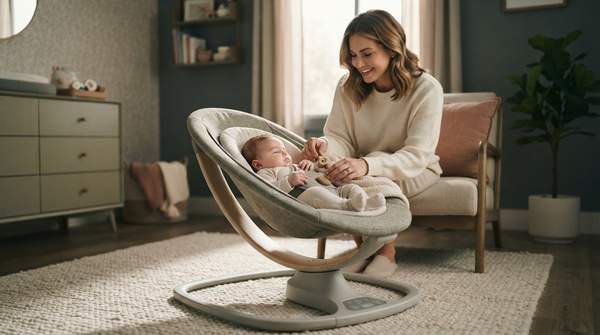
If you want app-controlled, multi-motion soothing, the 4moms MamaRoo Multi-Motion is the tech-forward choice—but it doesn't fold and carries a $270 list price. If you want quiet, compact quality, the Maxi-Cosi Cassia earns top quality marks at $200. And if you want a swing that travels and takes minimal space, an Ingenuity portable model gives you six speeds and music at a budget price, with no smart features at all. That trade-off—advanced technology versus mobility and cost—is the decision you're actually making, and this comparison breaks it down model by model.
Choosing Your Baby's Perfect Swing: Smart Features vs. Portability
Every baby swing on the market asks you to sacrifice something. Independent testing by BabyGearLab, which scored swings on quality, entertainment, portability, and assembly, found that this gear category demands trade-offs: impressive performance at a reasonable price is hard to find, and you generally have to spend more to get something worthwhile. The most important split is between feature-rich, stationary swings and simple, portable ones. The MamaRoo and Cassia both earn portability scores of just 5.0 in BabyGearLab's testing, and neither folds. Portable Ingenuity models flip the equation: they fold and save space but skip app control and multi-motion engineering. Before comparing models, decide which side of that line you live on.
High-Tech Comfort: The 4moms MamaRoo Multi-Motion
BabyGearLab labels the MamaRoo Multi-Motion an "Infant Swing for Tech-Heads," and the description fits. Its pros include customizable settings, unique motions, and a Bluetooth-enabled app that lets you control the swing from your phone—features no other model in this comparison offers. It weighs 15 pounds, measures 26.25 inches long by 23.5 inches wide by 35.5 inches high, runs on an AC adapter, and offers five speed settings with a convertible harness that shifts from a 5-point to a 3-point configuration as your baby grows.
The compromises are just as real. BabyGearLab lists it as expensive at a $270 list price, and it doesn't fold, so it will occupy its footprint in your home permanently. Testers also found it noisy. With an overall score of 60—including an entertainment rating of just 4.0—the MamaRoo is best suited to parents who genuinely value its distinctive motions and app control and have the space and budget to match.
Compact Quality: The Maxi-Cosi Cassia Swing
Named BabyGearLab's Best Quality pick with a 67 overall score and a quality rating of 8.0, the Maxi-Cosi Cassia earns the highest overall mark among the models compared here. It lists at $200, weighs 13.5 pounds, and measures 27.95 inches deep by 26.77 inches wide by 35.04 inches high. It runs on an AC adapter or battery power, offers five speed settings, and includes recycled fabric, a lightweight build, and a durable frame among its pros, along with what BabyGearLab calls a smart interface.
Wirecutter's testers add practical context: the Cassia is designed for babies from birth up to 20 pounds and was the quietest swing they tested, with a near-silent motor that barely registered on their sound meter. A simple touchscreen selects among five speeds and 12 sounds, the seat offers two recline angles, and you can manually rotate the seat a full 360 degrees. It also includes a motion sensor mode that starts the swing when your baby moves or fusses. The drawbacks, per BabyGearLab: it doesn't fold, its mobile is unremarkable, and its motions are limited. At 10 pounds per Wirecutter's testing, it's still easy to move from room to room.
On-the-Go Soothing: The Ingenuity Portable Swing
For parents prioritizing mobility and price, BabyGearLab highlights the Ingenuity Portable Swing as an inexpensive option whose benefits are portability and minimal space use—valuable when baby gear starts crowding your home. Manufacturer specifications confirm the approach: the Ingenuity Soothe 'n Delight portable swing offers six speeds, music, a foldable portable design, and a cushioned seat, suitable for newborns to 9 months and 6 to 20 pounds, made by Kids2. Another Ingenuity model, the Swing 'n Go sold at Target, runs on battery power with five speeds and nature sounds.
What you give up is everything the premium models deliver: no app, no Bluetooth, no multi-motion engineering, and no touchscreen. If your priority is a swing that folds away, travels easily, and soothes with basic speed and sound options at a fraction of the cost, this category fits. If you find yourself wishing for a motion sensor or customizable motions, you've chosen the wrong side of the trade-off.
Baby Swing Comparison: Features, Size, and Portability
The table below places the three approaches side by side, so you can see exactly what each model asks you to give up. Note that BabyGearLab's specifications supply exact dimensions for the two premium swings, while the Ingenuity models are described by their portable design rather than published measurements.
| Model | Key Feature | Dimensions (Unfolded) | Weight | Portability | Smart Features |
|---|---|---|---|---|---|
| 4moms MamaRoo Multi-Motion | Unique motions, customizable settings; five speeds | 26.25" L x 23.5" W x 35.5" H | 15 lbs | Stationary; doesn't fold | Bluetooth-enabled app |
| Maxi-Cosi Cassia | Whisper-quiet operation, touchscreen with five speeds and 12 sounds, two recline angles, 360-degree seat rotation, motion sensor mode | 27.95" D x 26.77" W x 35.04" H | 13.5 lbs (BabyGearLab); 10 lbs (Wirecutter testing) | Stationary; doesn't fold, but easy to move around the house | Touchscreen interface; no app mentioned |
| Ingenuity Portable Swing | Five or six speeds, music, nature sounds, cushioned seat; newborn to 9 months, 6–20 lbs | Compact, foldable design; exact measurements not published in the compared sources | Lightweight build (specific weight not stated) | Foldable, portable design | None; basic speed and sound controls |
Read down the Portability and Smart Features columns and the pattern is unmistakable: the only model with app control is the one that doesn't fold, while the only foldable model has no smart features at all. The Cassia sits in between—no app, but a touchscreen, motion sensor, and quiet motor—making it the compromise for parents who want more than basic controls without the MamaRoo's price or noise.
Making Your Decision: Prioritizing Features, Size, and Budget
One caveat before you buy: this comparison draws on manufacturer specifications and third-party reviews from BabyGearLab and Wirecutter, not hands-on testing by our staff, and it covers a representative selection rather than every swing on the market. Nothing here is medical guidance on swing use or duration. Within those bounds, the decision framework is straightforward: if soothing variety and phone control top your list and you have $270 plus a permanent corner, the MamaRoo fits. If quiet operation, quality, and a slightly smaller footprint matter more, the Cassia at $200—BabyGearLab's Best Quality pick—earns its price. If your swing needs to fold, travel, or squeeze into a tight space, an Ingenuity portable model delivers the essentials inexpensively.
Choosing Your Ideal Baby Swing: A Practical Decision
Select a baby swing based on a clear prioritization of either advanced soothing features and smart controls (often implying a stationary, larger footprint) or compact, foldable portability (often with simpler motion and sound options). The measurable indicator that you chose well is simple to check: the chosen swing fits comfortably in its designated space and provides the expected level of soothing or portability without requiring frequent adjustments or causing frustration due to its size or lack of desired functionality. Measure your intended corner against the published dimensions above—roughly two feet by two feet of floor space for either premium model—before you commit, and the decision will largely make itself.
Sources
- The Best Baby Swings — BabyGearLab
- The Best Baby Swings — Wirecutter: Reviews for the Real World
- Amazon.com : Ingenuity Soothe 'n Delight Portable Baby Swing for Infant, Newborn…
- Ingenuity Swing 'n Go Portable 5-Speed Baby Swing with Nature Sounds - Hugs & Hoots — TARGET